
Prolonging Death at the End of Life By Theresa Brown, R.N.
Before I became a nurse I taught English at Tufts University. I always had my students read a short story called “The Ones Who Walk Away From Omelas,” by Ursula K. Le Guin. It’s a story about a beautiful city called Omelas, filled with happy, prosperous people and their children, whose lives are untroubled by sadness or pain.
But there’s an ugly secret. For Omelas to prosper, one child must live in a small, dank, windowless basement room, undernourished, fetid and neglected. It’s a killer story, and I had my students read it so we could discuss how a society’s achievements sometimes can’t be separated from the misery of others.
We recently had a patient on my hospital floor who painfully brought to mind that suffering child and the story of Omelas. He was young, in his 20s, and had undergone an allogeneic stem cell transplant as the only chance of curing his cancer. He had many of the more severe complications that can occur with this treatment. A virus had turned his urine red with blood. His transplanted cells attacked his own body, leaving him temporarily blind and causing his skin to age unnaturally. His liver was slowly failing. He had almost constant diarrhea and for long periods got his only nutrition intravenously.
For months he stayed on our floor, slowly getting worse. In the end he couldn’t live without constant transfusions. Every time he stood up he leaked blood. Then his mind started to fail, too.
His doctors continued to throw one last-ditch treatment after another at him. Not one of them made a real difference in the patient’s condition, and each came with its own set of potentially dangerous side effects. Finally, and against the express wishes of at least one of his doctors, his parents decided to stop all medical care. Soon after they watched their son die.
Scenes like this are all too common in U.S. hospitals today. That is why proponents of health care reform call for provisions that would encourage patients to talk about end-of-life treatment long before they get there. For this patient, a lot of money was spent on care that made him worse when it could have been used to make someone else better. But more than that, we prolonged his suffering, racked his body with one toxic treatment after another, and held out false hope to him and his parents.
Taking care of this patient also made some of the nurses on the floor yearn for a more humane job. As one put it, “This is torture.”
Many of us found it hard to come to work. The young man wasn’t my patient, but we all knew him and his parents by sight, and knew their story. As time passed I began to feel deeply ashamed of what we were doing to him. The professional label for the feelings we nurses had is “moral distress,” the anxiety, fatigue and hopelessness that providers experience in the face of medically futile care.
The aggressive treatment reminded me of Omelas. In this case, the shining city was the edifice of modern cancer treatments and modern medicine in general.
Medicine today achieves great things, but too often when patients have no hope of surviving we use technology and drugs simply to keep people alive. Those racked bodies give us the peace of mind that when our time comes “everything will be done,” and we will get our own chance at a miracle. This patient’s suffering was one way, for the doctors at least, to keep the dream alive.
He was charming, friendly, good-looking; everyone wanted him to get better, to live. But believing that we could save him did not make saving him possible.
Ms. Le Guin’s short story ends by explaining that a few residents of Omelas become so distressed to learn of the suffering child that they decide to leave the shining city, never to return.
It’s estimated that as many as 15 to 25 percent of nurses quit their jobs as a result of moral distress, also never to return. We do such good work here, and in truth I mostly love my job. I don’t want to be among the ones who walk away from Omelas.
Thursday, September 10, 2009
Monday, August 24, 2009
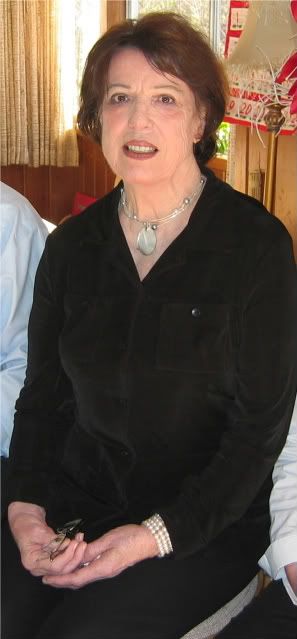
Remembering My Mother


It's two years today that my mother passed away. I still think about her everyday. I still miss her deeply.
She was such a vibrant, fascinating woman! She traveled the world, lived in Germany, Australia and Singapore.
She was outrageous, audacious, hilarious and courageous.
She was an artist and a writer. She spent her time here on earth questioning, examining and contemplating life, death, and everything inbetween.
A one-woman discoverer.
I love you forever, Mother.
Tuesday, June 2, 2009
Happy Birthday to Me

I'm 51 years old, or 49 if I count backwards, Katharine Hepburn style.
Sometimes I feel every inch my age, but mostly I still feel youngish.
What have my 51 years taught me?
Never say never.
Anger is destructive.
If you don't know what to do, don't do anything. Sometimes letting a situation play itself out is the best thing. Sit on your hands and keep your mouth shut.
Is there a purpose to everything? Sometimes. Mostly though, it's caused by humanstupidityfrailty.
Why do bad things happen to good people? Because we're all in the same boat. Good people just feel better about themselves and spread that goodness around.
Flossing your teeth is essential and don't forget to brush your gums as well as your teeth!
Get out of your rut and try new things. Even if it means dragging yourself out the door kicking and screaming.
Practice being kind every day.
Don't freak out. People will talk about you if you freak out.
Trust your intuition. Take your time. Get some sleep. Eat chocolate.

Tuesday, May 12, 2009
I am.
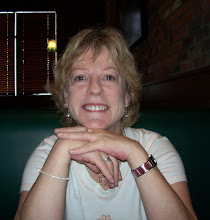
An over-exposed picture of me that turned out kind of cool!

Life is going well. I went through a bout of depression a while back - well, it was rather a long bout - over a year, at least, but it took me some time to realize that not wanting to get out of bed in the morning and not finding anything in my life about which to feel happy were tell-tale signs that things were not as they should be.
A visit to the doctor resulting in going on an anti-depressant fixed me right up.
Brain chemicals can get seriously out of whack. There's no shame in treating that.
I'm happy to say that I feel a whole lot better about my life now.
My job is going well. I learn something new everyday and there's never a dull moment. Being a nurse makes me proud and nurtures my soul in ways I can't describe.
Helping the sick is extremely gratifying. Talking to the patients, getting to know them, listening to their stories (never boring), and trying to make a difference for them - as simple as bringing a cup of coffee and as complicated as saving a life - is what fulfills me.
Holding the hand of someone who is about to die; someone with a terminal disease who has chosen not to have extreme measures taken, and being present with them in those last days, is a sacred honor.
I learn something from every patient. I learn about life, death, love, fear, anger, joy, and the beauty of the the human experience.
I have a wonderful son, a loving and supportive family, and friends who are cherished in my heart.
I am blessed.

some don't take their pills
others want more
some want to stay insane and others
to forget they are
I just write I am I am I am
-Leonardo Alishan-
Life is going well. I went through a bout of depression a while back - well, it was rather a long bout - over a year, at least, but it took me some time to realize that not wanting to get out of bed in the morning and not finding anything in my life about which to feel happy were tell-tale signs that things were not as they should be.
A visit to the doctor resulting in going on an anti-depressant fixed me right up.
Brain chemicals can get seriously out of whack. There's no shame in treating that.
I'm happy to say that I feel a whole lot better about my life now.
My job is going well. I learn something new everyday and there's never a dull moment. Being a nurse makes me proud and nurtures my soul in ways I can't describe.
Helping the sick is extremely gratifying. Talking to the patients, getting to know them, listening to their stories (never boring), and trying to make a difference for them - as simple as bringing a cup of coffee and as complicated as saving a life - is what fulfills me.
Holding the hand of someone who is about to die; someone with a terminal disease who has chosen not to have extreme measures taken, and being present with them in those last days, is a sacred honor.
I learn something from every patient. I learn about life, death, love, fear, anger, joy, and the beauty of the the human experience.
I have a wonderful son, a loving and supportive family, and friends who are cherished in my heart.
I am blessed.
Thursday, March 19, 2009
Poetry
The Crystal GazerI shall gather myself into my self again,
I shall take my scattered selves and make them one.
I shall fuse them into a polished crystal ball
Where I can see the moon and the flashing sun.
I Shall sit like a sibyl, hour after hour intent.
Watching the future come and the present go -
And the little shifting pictures of people rushing
in tiny self-importance to and fro.
- Sara Teasdale
I love poetry. I love poetry by women. It took me a while to find this one by Sara Teasdale - (thank you Google.)
I think I was around 15 years old when I first started to write poetry. I have no idea what prompted me. No one else in my family wrote poetry, and it was never a topic of conversation. In her later years, my mother wrote poetry, too.
What is it about poetry that it provides a method of 'release'? It's a way of expressing something that touches us, impacts us, in a creative, sometimes allegorical manner. It's a picture painted with words.
Creativity - An original means by which humans relay their responses to inner and outer experiences. (I just made that up, but it sounds good to me.) Dictionary.com describes it thus: "to create meaningful new ideas, forms, methods, interpretations." (That's good too.)
For me, it's a way to express an emotion. A catharsis, a celebration, a tribute or a purging. That's probably universal to all poets.
Even chickens.

Saturday, February 28, 2009
Saturday, February 7, 2009
Nursing Shortage
The average age of nurses is fast approaching 50! I'm 50 (still can't wrap my mind around that!) so I'm in the statistical cohort exactly.
On reading some articles about the issue of a huge number of nurses approaching retirement or moving to jobs away from the bedside, and not enough new nurses to take their place, it seems a general consensus that retention of the older nurses is a hot topic.
The big buzz is that older nurses are actually more valuable right now (and probably always have been) due to their wealth of knowledge and experience. Given that fact, employers should be looking to increase wages for the experienced nurses as a means of retention. Wouldn't that be great!
But alas, the economy is not cooperating at the moment.
What will happen when more and more experienced nurses leave the bedside? I hate to even speculate. I don't think I need to spell it out.
What about recruitment of younger nurses? How many are entering the profession now?
I read an abstract of a study done on young people's perception of Nursing. It boils down to this: "The majority of young people make a career choice without regard for salary, and base their decision on interest and enjoyment or a desire to help people. The findings indicate that although young people expressed admiration for the work of nurses, this was rarely matched by an envy of nurses, or a desire to become a nurse themselves." Career desirability: young people's perceptions of nursing as a career." (Hemsley-Brown & Foskett.)
Interesting. Obviously work needs to be done to promote a better, more enviable portrait of Nursing as a career. I'd like to see that. Truly, the image of Nursing as a profession by the general public is woefully skewed and fraught with stereotyping.
As a profession, I'd say we'd do well to focus on these issues with more gusto. Or else.....we'll see this decline -
Ironically, it's even difficult to find a non-stereotypical image of the Nursing decline.
On reading some articles about the issue of a huge number of nurses approaching retirement or moving to jobs away from the bedside, and not enough new nurses to take their place, it seems a general consensus that retention of the older nurses is a hot topic.
The big buzz is that older nurses are actually more valuable right now (and probably always have been) due to their wealth of knowledge and experience. Given that fact, employers should be looking to increase wages for the experienced nurses as a means of retention. Wouldn't that be great!
But alas, the economy is not cooperating at the moment.
What will happen when more and more experienced nurses leave the bedside? I hate to even speculate. I don't think I need to spell it out.
What about recruitment of younger nurses? How many are entering the profession now?
I read an abstract of a study done on young people's perception of Nursing. It boils down to this: "The majority of young people make a career choice without regard for salary, and base their decision on interest and enjoyment or a desire to help people. The findings indicate that although young people expressed admiration for the work of nurses, this was rarely matched by an envy of nurses, or a desire to become a nurse themselves." Career desirability: young people's perceptions of nursing as a career." (Hemsley-Brown & Foskett.)
Interesting. Obviously work needs to be done to promote a better, more enviable portrait of Nursing as a career. I'd like to see that. Truly, the image of Nursing as a profession by the general public is woefully skewed and fraught with stereotyping.
As a profession, I'd say we'd do well to focus on these issues with more gusto. Or else.....we'll see this decline -

Ironically, it's even difficult to find a non-stereotypical image of the Nursing decline.
Subscribe to:
Posts (Atom)
About Me
- i~RN
- I'm a young woman of 50 years on this earth... I'm a single Mom... I'm an RN... I'm a writer.